Receivables · 24 September 2026
How Wholesale Credit and Customer Balances Should Work
Invoices, running balances, and partial payments for distributors who sell on credit and still need a number they trust. Written for credit wholesalers.
Most wholesalers sell on credit. The risk is not the idea of credit — it is losing track of who owes what after a busy week. Spreadsheets work until two people edit different copies, or a partial payment is written on a scrap of paper and never entered.
Good customer receivables software keeps the balance next to the sales and stock that created it. For Pakistan-specific collection habits (including WhatsApp reminders without an API), see receivables software in Pakistan.
1. Start from the invoice, not a vague total
Wholesale credit fails when the only number you have is “he owes about this much.” Every credit sale should create an invoice that increases a named customer’s balance. Cash sales should not invent a receivable.
2. Partial payments are normal
Customers rarely clear an invoice in one go. Record each receipt against the customer (and ideally the invoice). The remaining balance should stay visible so the next collector does not restart from a notebook.
3. Overdue needs a list, not a memory
A receivables list that shows who is overdue — and by how much — beats asking the senior salesman who “knows everyone.” Open the customer, see unpaid invoices, then call or message with specifics.
4. Statements settle disputes faster
When a shop says the total is wrong, share invoices and payments for that account. If your records and theirs cannot match, fix the master data or the payment date — do not invent a new spreadsheet.
5. Currency should match how you trade
If you invoice in USD, AED, GBP, INR, or PKR, balances should display in that currency. ProDistro locks the company currency after the first sale or purchase so old invoices are not silently rewritten.
If you are still on Excel, use the Excel migration checklist before you import messy balances. When you are ready to try the product, start a free trial or see pricing.
How should a credit invoice change the balance?
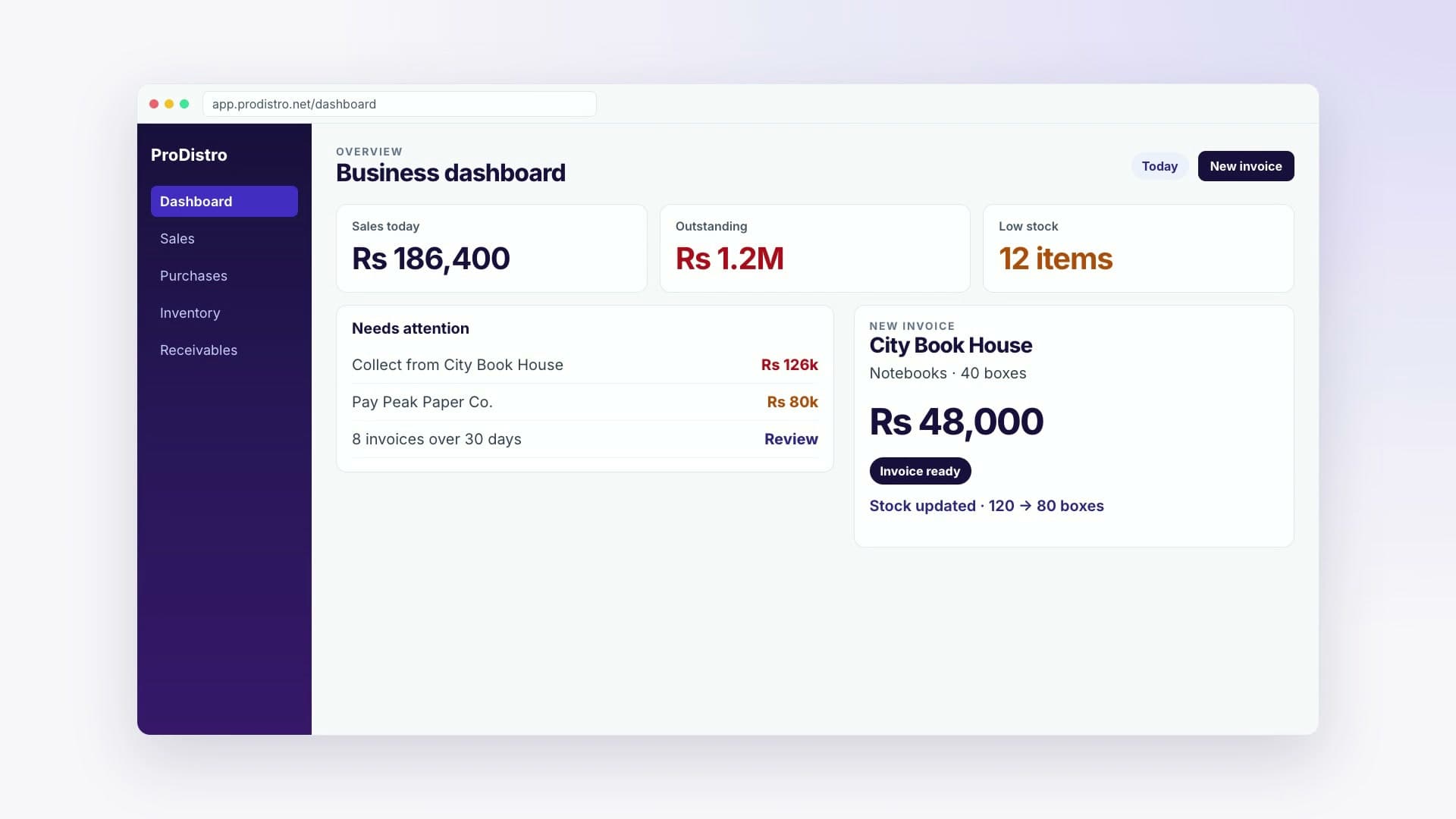
A credit sale does two things at once. Stock falls by what you delivered, and the customer’s outstanding balance rises by the invoice total. Cash in the drawer does not move. If your books only move when cash arrives, you are recording a cash business and running a credit business, and the gap is the money people owe you. The invoice is the record of that gap. It should name the customer, the goods, and the amount. A day-book total with no customer is not a receivable.
Post the invoice when the goods leave, not at the end of the week when someone has time. A week of unposted delivery notes is a week of balances that are too low, and a week of stock that is too high. Collectors then ask for less than they should, and the next order is accepted because the screen says the account is fine. The screen is fine only if it includes today’s invoices.
The balance on the customer should be the sum of what is still unpaid. You should be able to open it and see those invoices. A single typed total cannot be split when the customer says one of the bills was already settled. Partial settlement is normal. An unexplained total is how disputes last a month.
What belongs on the receipt when the payment is only part of the bill?
The receipt needs the customer, the amount, the date, and which invoice it reduces. The balance falls by that amount and no further. Leave the rest of the invoice open. If the customer hands you a round sum that covers two invoices and part of a third, say so on the receipt, or allocate it in that order and tell them what remains. “Received cash” with no allocation feels recorded and is not. Next week both sides will remember a different bill.
Do not clear the whole invoice because most of it was paid. The remainder is still money owed, and it is often the part that never gets chased, because the invoice no longer appears on the open list. Keep it open until the last rupee is posted. Write off only when you have decided the remainder will not be collected, and record that as its own entry so the invoice history still explains the original amount.
When do you stop the next credit sale?
Decide the rule outside the software, then apply it where the next invoice is written. Some shops stop an account when the oldest invoice passes a number of days. Some stop it when the balance passes an amount the owner set. Either rule fails if the person writing the invoice cannot see the balance. Put the balance on that screen. A credit limit field you never look at does not change the delivery.
Follow up on a rhythm, not when cash is short. The largest balances and the oldest invoices first. A WhatsApp reminder you send yourself is enough for many distributors. The message should mention the amount and, when you can, the invoice. ProDistro prepares that text. You still send it. It will not collect for you, and it should not pretend a payment exists before you post the receipt.
The page that matches this workflow is customer receivables software. The weekly collection sequence is on managing outstanding balances.
How do you keep the salesman and the counter on the same bill?
The salesman often collects on the road and the counter posts in the evening, or nobody posts until the owner asks. Give every collection a slip the same day: customer, amount, and the invoice numbers it covers. The counter posts from the slip, not from memory of “he usually pays ten thousand.” If the slip is missing, the balance stays open and the follow-up will ask for money already in the drawer. That double ask costs you the account faster than a slow delivery does.
A new order taken while the customer still owes is allowed only when someone looked at the balance first. If the salesman cannot see it, he will take the order, and the argument moves to the loading bay. Print or show the open invoices before the goods leave. If you decide to supply anyway, that is a decision by the person allowed to extend credit, not an accident of a van that left early. The invoice for the new goods then adds to the same balance. It does not replace the old bills.
Close the day by matching the cash and transfers you hold to the receipts posted. The difference is either a slip not entered or cash not yet in the drawer. Find it before the next morning’s list is built. A credit system that is reconciled weekly will spend the week chasing the wrong people. Daily posting is the habit. The software can show the balance. It cannot guess which notes are still in a pocket.
If a customer pays the salesman and the counter on the same day, post both receipts before anyone sends a reminder. Two collections against one invoice should leave the remainder, or zero, and never a negative that you “fix” by deleting a receipt. Say the remaining figure to the customer once. A second message the next morning that asks for money already posted is how a correct balance still feels wrong.