Receivables · 25 July 2026
Manage Wholesale Customer Balances
A practical sequence for credit sales, overdue invoices, partial payments, and the follow-up a wholesale collector actually does. Written for distributors.
Most Pakistani wholesalers sell on credit. The problem is rarely “we do not know credit exists” — it is that balances live in notebooks, phone notes, and half-updated Excel files until someone asks “how much does this shop owe?” and nobody trusts the answer.
A practical weekly process
- Record every credit sale as an invoice — not as a verbal promise. Without a bill, collections become arguments.
- Keep one outstanding list by customer — total due, not twelve scattered chats.
- Open the unpaid invoices behind each total when a customer disputes the figure.
- Accept partial payments cleanly — update the balance the same day cash arrives.
- Follow up on a schedule — for example, overdue over 14 or 30 days — with a written reminder that includes the amount.
What “good” looks like in software
Useful customer receivables software for distributors should show outstanding balances, unpaid invoices, payment history, customer statements, and a way to record receipts. ProDistro also lets you copy a reminder and open WhatsApp with the amount prepared — without requiring a WhatsApp Business API. You still send the message yourself; the software removes the typing and lookup work.
Common mistakes
- Updating Excel once a week while sales happen every day.
- Recording only totals without invoice references.
- Taking cash without posting a receipt, so the balance never drops.
- Waiting until month-end to chase everyone at once.
How ProDistro supports this
In ProDistro, credit sales create invoices that feed customer balances. The receivables views help you see who owes money, drill into invoices, record partial payments, pull statements, and follow up. It will not magically collect cash for you — it makes the follow-up list honest and actionable. For the full product picture, see distribution management software in Pakistan.
Related: what to look for in distribution software · leaving Excel behind.
How do you keep a customer balance equal to unpaid invoices?
A wholesale balance is not a number someone types on Friday. It is the credit invoices you have posted, minus the receipts you have posted, for that customer. If the figure on the screen is a total from a notebook, it will drift the first day a partial payment is written on paper and never entered. Open the customer and you should see the invoices that make up the balance. If you cannot point at the bills, you cannot answer a customer who says they already paid.
Start the day with that rule for new sales only if you must, but agree the opening balance first. The opening figure is what you both accept they owed on the morning you switched. Everything after that is a transaction. Do not edit the opening figure every evening to force the total to match a feeling. If the total is wrong, a receipt is missing, a credit note was not posted, or an invoice went to the wrong customer. Find that transaction.
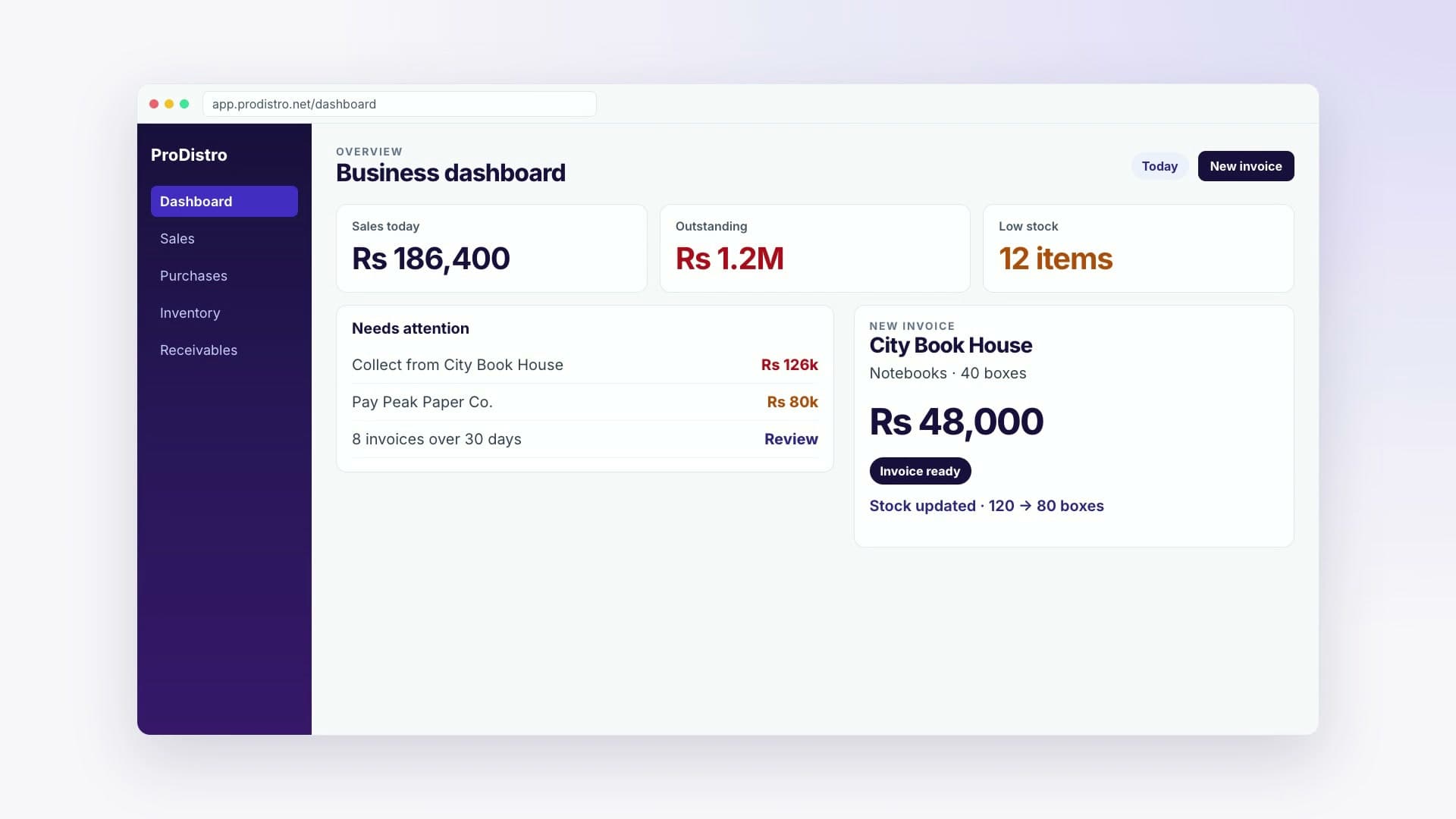
The photo on this page is the workspace view that puts sales today next to outstanding balances. The balance list is the collection list. It is only honest if the receipts from yesterday are already in it before anyone leaves.
What do you do when the customer pays part of one bill?
Record the amount you received against that customer, and leave the remainder on the invoice. The balance should fall by exactly the amount you took, not to zero, and not by a rounded figure someone prefers. Say the remaining number out loud before the customer leaves. If you only write “paid some” in a chat, the next collector will ask for the full invoice and the argument starts.
Cash that is not posted does not reduce the balance. That sounds obvious, and it is the most common miss on a busy counter: the money is in the drawer, the invoice still shows open, and the follow-up message asks for cash you already have. Post the receipt the same day, with the customer’s name and the invoice it belongs to. A lump sum that covers several invoices should say which invoices it covers, or the next statement will not match the customer’s own notes.
How do you run the collection list?
Once a week, sort by who owes the most and by who has gone quiet, not by who is easiest to call. For each account, open the unpaid invoices, note the oldest, and decide whether you will deliver the next order. A new credit sale to an account you have not collected is a choice, and it should be a choice you can see, not an accident because the balance lives in another file. Stop-supply is a business decision. The software’s job is to make the balance visible at the moment the next invoice is written.
Reminders can be a message you send yourself. ProDistro can copy the amount and open WhatsApp. It does not send the message through an API, and it does not collect the cash. The person who sends it should be looking at the same invoices the customer will ask about. A reminder with no invoice references is the notebook problem in a new window.
Read customer receivables software and the companion note on how wholesale credit should work.
What do you say when the customer disputes the total?
Open the invoices, not the total. Read the dates and the amounts that are still open, and ask which of those they believe they paid. A dispute about a total is usually a dispute about one bill, or about a payment that was handed to a salesman and never posted. If you only have a single number, you will negotiate the number. If you have the bills, you can mark the one they paid and leave the others. That is the whole reason the balance must be the sum of open invoices.
When you find the missing receipt, post it on the day you find it, against the invoice they named, for the amount they actually paid. Do not backdate a story you cannot support, and do not delete the invoice to make the argument stop. Deleting the invoice removes the goods movement as well if the sale and the stock are one record, and then the shelf will not match either. Correct with a receipt or a credit note for goods that really came back.
After the conversation, the remaining balance on the screen should be the number both of you just said. If the customer leaves and the screen still shows the old total, the receipt was not posted and the next person will start the same argument. Do it before they reach the door. A statement printed from that screen is what you can send later. A statement rebuilt in a sheet will drift again by the next delivery.
Keep the oldest open invoice visible when you take the next order. If that invoice is the one the customer still disputes, settle the dispute before you load another delivery on top of it. Adding a new bill to an unresolved one makes the next argument about two deliveries instead of one. The balance can grow. The unexplained part should not.
If the customer’s own list and your open invoices still disagree after that, write down the invoice numbers on both sides before anyone leaves. The next collection starts from that note, not from a new total typed over the balance.