Pharma · 25 July 2026
How Medicine Distributors Can Reduce Expiry Losses
Practical ways to cut medicine expiry losses: near-expiry alerts, slow-moving batches, FEFO, return planning, and stock value at risk.
Expiry losses are quiet. Stock looks fine until a batch crosses the date and becomes worthless. Distributors who wait for month-end inventory counts discover write-offs too late to sell or return.
30-, 60-, 90- and 180-day expiry attention
Bucket near-expiry stock by days remaining. Thirty days is urgent action; 90–180 days is planning — push sales, stop over-buying, or start supplier conversations. Exact alert thresholds depend on your product mix; the discipline is reviewing the list weekly.
Slow-moving batches
A long-dated batch that never sells is still capital at risk if demand dies. Combine expiry views with sales velocity: slow movers with medium expiry deserve attention before they become short-dated dead stock.
Return-to-supplier planning
Many principals accept near-expiry returns under contract windows. You only catch those windows if expiry is visible by batch. Without batch dates, return claims become arguments.
Halfway tip
If you want software that already ties purchases to batches and sales to FEFO, start with ProDistro medicine inventory software or the fuller pharma distribution software page, and book a demo when you are ready.
FEFO as daily protection
Near-expiry reports find risk; FEFO reduces how often short-dated lots are left behind. Both matter.
Stock value at risk
Translate near-expiry quantities into rupees using purchase cost. A “small” pile of expensive antibiotics can dwarf a large pile of cheap tablets. Value-at-risk focuses the team on what hurts cash, not only unit counts. Pair this with solid batch tracking.
How do you cut expiry losses before the date arrives?
A medicine distributor loses money on expiry when a saleable batch sits while a longer-dated batch of the same product leaves the warehouse. The fix starts on the purchase, not on the write-off. Every receipt of a medicine needs a batch number, an expiry date, and a quantity in the unit you will sell. If that line is blank, a later report cannot tell a short-dated lot from a fresh one, and the counter will sell whichever carton is nearest the door.
Once the dates are on the receipt, the weekly job is a list, not a feeling. Open the batches that expire inside 30 days, then 90, then 180. For each line, read the quantity still saleable and the supplier the lot came from. Thirty days is a sales or return decision this week. Ninety days is a buying decision: stop the next order until this lot moves. One hundred and eighty days is a watch list, useful when the product is expensive and slow.
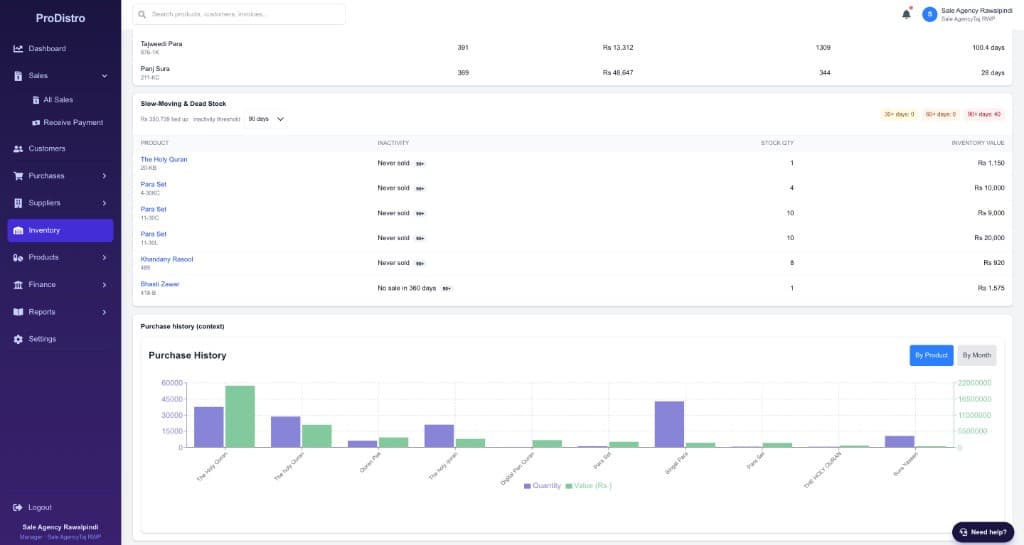
Pair that list with how fast the product has been selling. A long-dated batch that has not moved is still cash sitting on a shelf. A short-dated batch of a product that sells every day is a routing problem: put it on the next invoice. ProDistro keeps the batch on the stock record so that list is the same stock the invoice will draw from. It does not phone the customer or invent a discount. Someone still has to offer the short-dated lot to an account that will accept the date.
What do you do with stock inside 30 days?
Inside 30 days, pick one action per batch and write it down. Sell it first, return it if the principal’s window is still open, or accept that it will be written off and stop buying more. Mixing those three in your head is how the same carton is “about to go back” for a month and then expires in the godown. The person who buys and the person who sells should look at the same five lines. If they disagree, the sale record from last week is the referee: either the short-dated lot was offered, or it was not.
Value matters more than the unit count. Price the near-expiry quantity at purchase cost. A small pile of an expensive antibiotic can be a larger loss than a large pile of a cheap tablet. Chase the rupee figure. When you talk to a customer, say the expiry and the quantity you can still supply. When you talk to a supplier, say the batch, the date, and whether their return window covers it. Without the batch on the original receipt, that conversation becomes an argument about a mixed pile.
FEFO is the daily version of the same habit. On a sale, the suggestion should be the earliest expiry that is still in the future and still has quantity. An expired batch stays out of that suggestion. Staff can override when a customer refuses the date, and the override should stay on the sale so next week’s review can see why the short-dated lot is still there. Read the walkthrough on FEFO for medicine distributors.
How do you run the weekly expiry review?
Give the review a fixed hour, with the buyer and one person from the counter. Bring the products that moved the most units and the products with the highest purchase cost. For each one, name the batch that should leave next, the customer or route that can take it, and whether a new purchase is already on the way. If a purchase is inbound for a product whose earlier batch has not cleared, cancel or delay it before the truck arrives. Buying more of a lot you cannot finish is how expiry losses repeat.
Keep a short note of the exceptions: customer refused the date, batch still on a van, return window missed, override with no reason. The first three are normal wholesale. The fourth is the one that needs a conversation. Do not wait for a full stock count to start this. A count tells you what is already unsaleable. The list tells you what is still saleable if you move it this week.
The product page for this workflow is medicine inventory software. Batch capture on the purchase, a sale that prefers the earlier valid expiry, and a weekly list you actually act on are the three controls. A report nobody opens is the same as no dates on the receipt.
Who looks at the list, and when?
Put the review on the calendar for the same morning each week, before the first van leaves. The buyer brings the purchases already placed. The counter brings the overrides from last week. If those two people never sit together, the buyer will reorder a product the counter already knows is stuck, and the counter will keep selling the long-dated lot because nobody told them the short-dated one is the priority. Fifteen minutes on five products is enough. A monthly meeting is too late for anything inside 30 days.
Write the decision on the batch, not in a chat that disappears. “Offer to the clinics on route two” or “return window closes Thursday” is a decision. “Keep an eye on it” is not. Next week, start with last week’s decisions and ask whether the quantity actually fell. If it did not, the offer was not made, or the customer refused and the override should already say so. Either fact is useful. A list that looks the same for three weeks is a list nobody is using.
Separate write-offs from near-expiry. Once a date has passed, the quantity is no longer a sales problem. Move it out of saleable stock so it cannot be invoiced by mistake, and stop including it in the “what can we push” conversation. Leaving expired cartons in the same pile as saleable ones is how a short-dated offer becomes an expired delivery. The weekly list should shrink as you act. If it only grows, you are buying faster than you are selling the earlier lots.